

GROWTH CASE 17 · THE CITATION ARRIVED BEFORE THE RECOMMENDATION
He Published 34 Self-Promotional Pages. AI Cited Them and Still Skipped His Conference 43% of the Time
Ahrefs tracked nearly four months of answers across ChatGPT, Gemini, Perplexity, and Copilot. A new conference entered 72 empty prompt slots, yet cited pages still handed recommendations to competitors.
10 min read
1 public cases · 3 cited sources
Finfold Editorial
Updated ·
Company-run experiment with a public method · Ahrefs published the 34 pages, 9,886 answers, and charts using its own Brand Radar. The work has not been independently replicated and includes no revenue attribution.
Mateusz Makosiewicz tested a tempting idea. If a brand publishes a best-of list and includes itself, will ChatGPT, Gemini, Perplexity, or Copilot recommend it? The Ahrefs team created 34 self-promotional pages for Brand Radar and its new Evolve conference across five domains, then tracked 9,886 answers from February 7 through May 31.
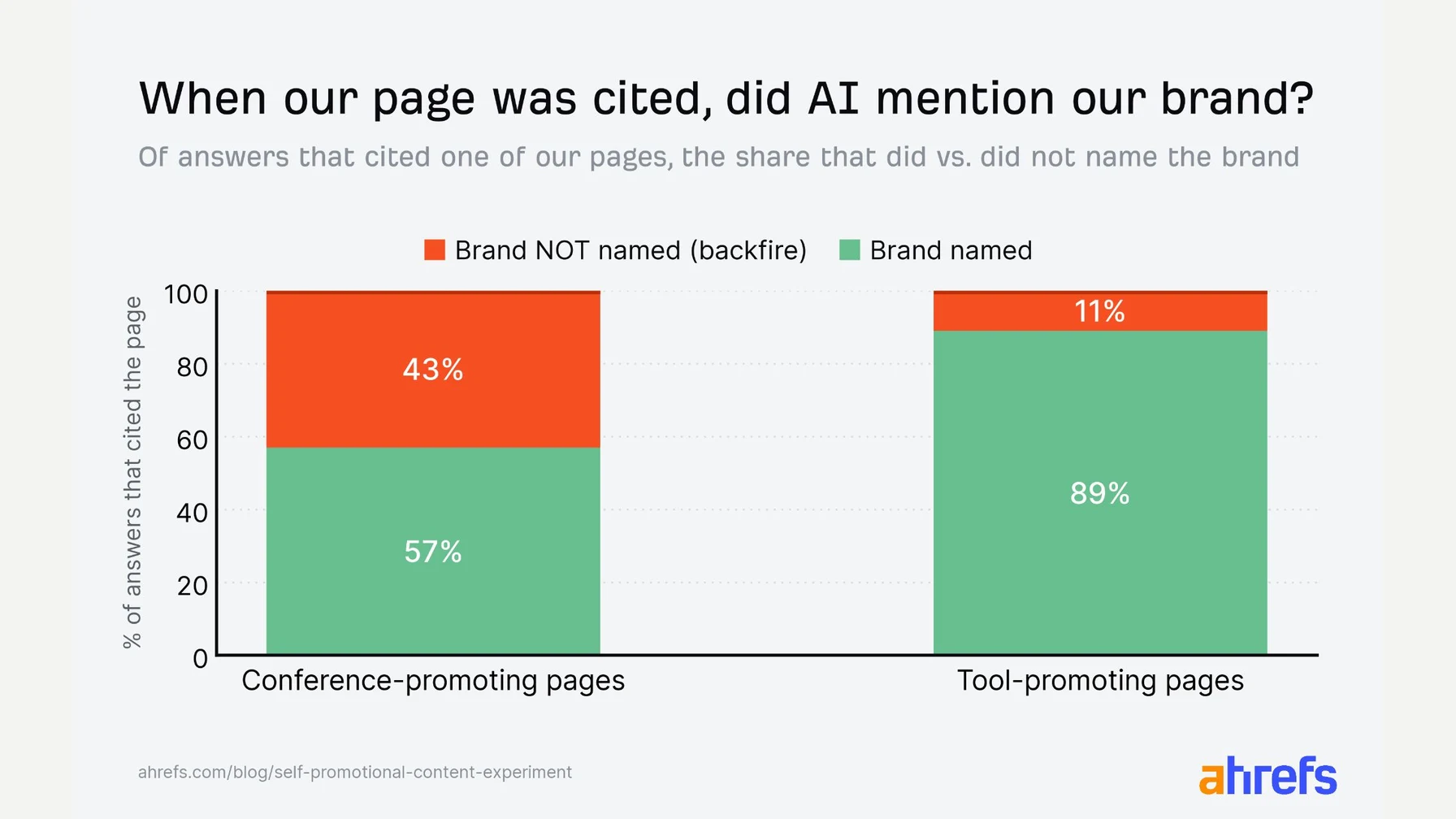
The new conference did enter 72 prompt-engine slots where it had previously been absent. Eighty-two percent of those new mentions appeared in answers citing an owned page. The catch sits in the same dataset. When an AI assistant cited a conference page, 43% of answers still omitted Evolve and could recommend another event from the list. The page earned a footnote while the brand stayed outside the answer.
Self-promotion helped the new name more than the familiar one
Evolve was absent during the baseline and later entered 72 new prompt-engine combinations. Eighty-two percent of those mentions appeared with a citation to a team page. The established Ahrefs Brand Radar brand barely moved the same way. Only 6% of its new-slot mentions cited an owned page, while 94% came from third parties.
The same format played very different roles. A self-promotional page can serve as a new category card when an assistant has little material connecting a brand to a narrow topic. An established brand already covered by third parties has less of that gap to fill.
Every competitor on the list stands between a citation and a recommendation
Conference pages had a 43% backfire rate under a narrow definition. An assistant cited a page promoting Evolve but did not mention Evolve in its answer. The comparable figure for tool-promoting pages was 11%.
The experiment does not prove why, but the page structure exposes the risk. A useful best-of list describes alternatives. An assistant can use that page as research and select another name. A GEO review that counts citations alone misses the decision. Brand mention, recommendation position, and click behavior need separate columns.
Some citations appeared once and changed seats the next day
About one quarter of pages were cited once for a prompt-engine combination and never returned. Recurring citations were patchy too, appearing on roughly one in three eligible days between first and last observation. The longest uninterrupted run lasted 52 days and clustered around Copilot and narrow conference or alternative queries.
A Monday screenshot cannot establish ownership of an answer. Repeat the same prompt on a schedule and store the model, date, market, and wording. A citation may disappear without any page change.
A small team can test GEO without publishing 34 pages
Choose three narrow comparison or purchase questions and test them twice a week in two assistants. Record which brands are mentioned, which are recommended, and which pages are cited. Then publish one comparison or experience page with standalone value, explicit selection criteria, limits, and sources.
After four weeks without a new mention, check indexing, query-brand fit, and the shortage of third-party evidence. Google's own guidance says its AI features retain foundational SEO practices and add no special eligibility layer. The test can observe movement. It cannot promise sales.
Open the 1 case records and their limits+
Mateusz Makosiewicz
Ahrefs Evolve 与 Brand Radar
Reported result · Evolve entered 72 empty slots and 82% of new mentions cited an owned page
What remains uncertain · Forty-three percent of answers citing conference pages still omitted Evolve, and citations frequently disappeared
Open the public recordSOURCES
What each link actually supports
- Named firsthandAccessed 2026-08-24Ahrefs self-promotional content AI-search experiment
Supports the method, 72 empty slots, 82%, 43%, 11%, and citation persistence results.
- Company-reportedAccessed 2026-08-24Study of 26,283 source URLs in self-promotional best lists
Provides broader company-reported context on AI use of self-promotional best lists.
- Official sourceAccessed 2026-08-24Google guidance for AI features and websites
States that AI Overviews and AI Mode use foundational SEO practices without extra technical requirements.
SMALL BET, REAL SIGNAL
Keep separate ledgers for citation, mention, and recommendation
01 / FIX PROMPTS
Choose three narrow questions and keep engines, market, and check times stable.
02 / PUBLISH ONE
Create one useful comparison with criteria, limits, and sources.
03 / SPLIT METRICS
Record citations, mentions, recommendation order, and clicks separately.
CONTINUE THE WORKFLOW
BRING YOUR OWN SOURCE
Check whether your source can carry a GEO / AI Search post.
Look for a person, a moment, evidence, and a consequence before generating a sentence.
Start with Finfold